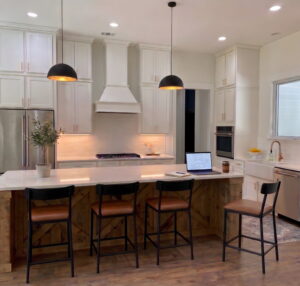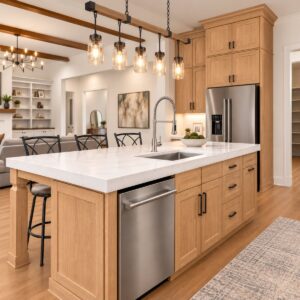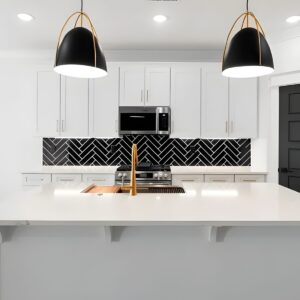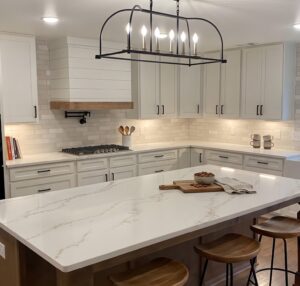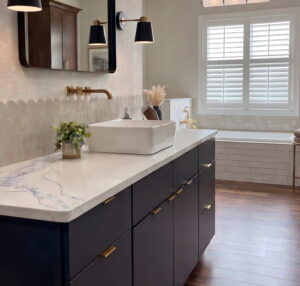
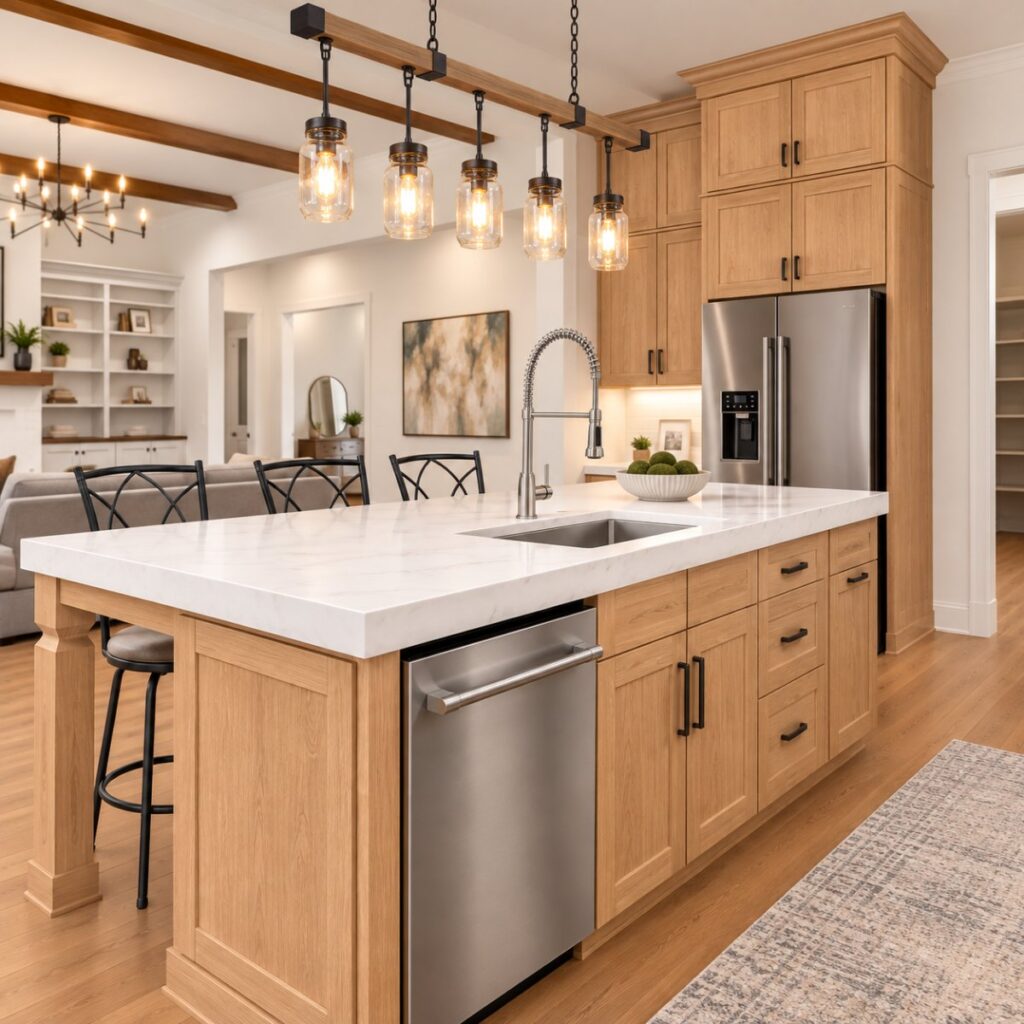
Wood kitchen cabinets are rarely made from one material from top to bottom. A cabinet may combine plywood or furniture board for the box, MDF or HDF for a painted door, solid hardwood for a face frame, and veneer or laminate for exposed surfaces.
For homeowners comparing wood kitchen cabinets, the most useful question is not simply, “Is this real wood?” Instead, look at which material is used for each cabinet part, how that material performs there, and whether the construction level fits your budget and expected use.
What Materials Are Kitchen Cabinets Made From?
Kitchen cabinets commonly use plywood, MDF, HDF, particleboard or furniture board, solid wood, veneers, and laminates. Each material behaves differently, so manufacturers often combine them rather than build an entire cabinet from a single wood product.
The cabinet box, door, drawer front, face frame, shelf, and finished exterior each perform different functions. A material that works well for a painted door may not be the first choice for a structural cabinet box, while solid hardwood may provide little practical benefit in areas that remain hidden.
For example, Century Cabinets' current specification guide identifies different materials by product level and component. Navigator and Altitude use furniture board box construction, while Summit uses plywood box construction. The same guide lists solid hardwood face frames as part of those construction systems.
That is why homeowners should compare cabinet construction as a system rather than judging quality from a single material name.
Plywood Kitchen Cabinets: Where Plywood Makes Sense
Plywood is made by bonding thin sheets of wood veneer together, with each layer positioned so the wood grain runs in an alternating direction. That layered construction gives plywood good dimensional stability and strength for cabinet boxes, shelves, backs, and other structural components.
For homeowners who expect heavy everyday use, plywood is often attractive because it holds fasteners well and provides a strong cabinet structure without requiring thick solid-wood pieces.
Advantages of Plywood
Plywood performs especially well in areas where cabinetry requires structural strength.
Common benefits include:
- Good resistance to bending and warping
- Strong screw and fastener holding
- High strength relative to its weight
- Good performance for cabinet sides, bottoms, shelves, and backs
- A natural wood surface, when finished with a hardwood veneer
Plywood is still a manufactured wood product, so quality varies. The wood species, veneer thickness, number of plies, adhesive, core construction, and finishing process can all affect performance.
Is Plywood Waterproof?
No. Plywood should not be treated as waterproof.
High-quality plywood generally handles normal changes in household humidity better than many lower-density composite panels, but prolonged exposure to leaks or standing water can still damage the veneers, adhesives, and finish.
That makes leak prevention important regardless of the cabinet material. Pay particular attention to cabinets beneath sinks, beside dishwashers, and around plumbing penetrations.
How Century Cabinets Uses Plywood
Century Cabinets' current specification guide identifies its Summit product level as plywood box construction. The guide specifies birch-veneered plywood with a UV clear finish for several box components and shelves.
This is a useful example of why homeowners should ask which construction level they are reviewing. A manufacturer may offer more than one cabinet-box material rather than using the same construction across every product level.
MDF Kitchen Cabinets: Why Engineered Wood Works Well for Painted Doors
Medium-density fiberboard, or MDF, is an engineered panel made from refined wood fibers combined with resin and compressed into a dense, uniform board. Its smooth surface makes it especially useful for painted cabinet doors and precisely machined profiles.
MDF does not have the visible grain, knots, or natural movement of solid lumber. For a painted finish, that consistency can be an advantage.
What Is MDF Best Used For?
MDF is particularly well-suited to:
- Painted cabinet doors
- Slab-style doors
- Routed door profiles
- Recessed center panels
- Decorative panels
- Components where a smooth, uniform finish matters
Because the surface is consistent, paint can appear more even than it does over natural wood grain.
Is MDF Durable Enough for Kitchen Cabinets?
Yes, when it is appropriately engineered and used in the right application. MDF can provide a durable cabinet door or panel, but it should be protected from prolonged exposure to moisture.
Unsealed MDF can absorb water and swell. Finished cabinet components rely on properly applied coatings and intact edges to help protect the substrate.
Homeowners should therefore judge MDF as part of the finished product rather than assuming every MDF component performs the same way.
Century Cabinets Uses MDF in Several Door Styles
Century Cabinets provides a useful real-world example of engineered wood being used intentionally rather than simply as a lower-cost substitute.
Its current specification guide lists:
- Currahee as an MDF door
- Oslo as an MDF slab door
- Yonah with maple stiles and rails and an MDF center panel
- Essentials with an HDF door material
These materials are matched to specific door constructions and profiles.
Century Cabinets currently describes Currahee as a wide Shaker design, Yonah as a beveled Shaker style, and Oslo as its modern slab option.
For a homeowner choosing painted wooden kitchen cabinets, this shows why “solid wood or nothing” is too simple a buying rule. An engineered center panel or MDF slab can be selected because its properties suit the design and finish.
What Is HDF, and How Is It Different From MDF?
High-density fiberboard, or HDF, is another engineered fiber panel. It is generally manufactured at a higher density than MDF, which gives it a hard, smooth surface suitable for detailed components and painted applications.
Like MDF, HDF offers consistency without visible natural grain variation.
Century Cabinets' current specification guide identifies HDF as the door material for its Essentials Shaker style.
If a dealer shows you an HDF or MDF cabinet door, ask about the complete door construction and finish rather than evaluating it only by the substrate name.
Particleboard and Furniture Board: Are They the Same Thing?
Furniture board is a broad industry term often used to refer to engineered panels made from wood particles bonded with resin. The exact density, composition, surface treatment, and manufacturing quality can vary considerably.
Particleboard should therefore not automatically be treated as either “cheap” or “bad.” Its performance depends on the panel grade, thickness, hardware attachment, edge treatment, cabinet engineering, and intended application.
Where Furniture Board Is Commonly Used
The furniture board can be used for:
- Cabinet sides
- Tops and bottoms
- Shelves
- Cabinet backs
- Interior panels
- Other box components
It tends to be heavier than plywood of comparable dimensions and generally has different screw-holding and moisture-response characteristics. However, a properly engineered furniture-board cabinet can still serve effectively in normal residential use.
How Century Cabinets Uses Furniture Board
Century Cabinets' specification guide identifies both Navigator and Altitude as furniture board box construction.
For those product levels, the guide specifies laminated furniture board across several wall and base cabinet components and pairs the box with a solid hardwood face frame. Altitude also includes dovetail drawer boxes and undermount soft-close drawer glides, per the current guide.
That combination illustrates an important buying principle: cabinet quality is not determined by the box panel alone. Drawer construction, hardware, face frames, shelves, joinery, finish quality, and overall engineering also affect how cabinetry performs.
Solid Wood Kitchen Cabinets: What Does “Solid Wood” Really Mean?
Solid wood means the component is cut from natural lumber rather than manufactured from bonded fibers, particles, or veneer layers. It is often used for cabinet face frames, door rails and stiles, moldings, and other visible or structural details.
However, most wood kitchen cabinets are not built entirely from solid lumber. Using multiple materials can improve stability, finishing consistency, cost efficiency, and performance.
Advantages of Solid Wood
Natural hardwood offers several benefits:
- Strong structural performance
- Good fastener holding
- Natural grain and character
- Ability to accept stains and clear finishes
- Long service potential when properly maintained
- Authentic variation from one piece to another
Those natural variations are part of the material.
Century Cabinets' warranty information specifically notes that variations in wood color, grain, mineral streaks, knots, age, and sunlight exposure are natural characteristics rather than defects. It also notes that climate change can cause expansion and contraction in painted wood surfaces.
What Are the Drawbacks of Solid Wood?
Natural wood responds to its environment.
Humidity changes can cause expansion or contraction. Grain patterns and color can vary from board to board. Painted joints may also become more visible as wood moves through seasonal changes.
For stained wooden kitchen cabinets, those variations can create the character homeowners want. For a highly uniform painted kitchen, engineered materials may offer practical advantages in selected components.
Plywood vs. MDF vs. Solid Wood vs. Furniture Board
There is no single cabinet material that performs best in every application. Cabinet manufacturers often use several materials within the same cabinet because boxes, doors, shelves, frames, and finished surfaces have different requirements.
Plywood
Plywood is commonly used for cabinet boxes, shelves, backs, and structural panels. Its layered construction provides strength and dimensional stability, making it well-suited for components that need to support weight and maintain their shape. Plywood typically costs more than furniture board, so its value depends on where and how it is used.
MDF and HDF
Medium-density fiberboard (MDF) is frequently used for painted cabinet doors, slab fronts, and center panels. Its smooth, consistent surface accepts paint well and lacks the visible grain or natural variations found in solid wood. It should be properly finished and protected from prolonged exposure to moisture.
High-density fiberboard (HDF) is denser than MDF and can be used for cabinet doors and detailed painted components. Like MDF, it provides a smooth engineered surface, although its performance depends on the construction method and protective finish.
Furniture Board
Furniture board is an engineered panel commonly used for cabinet boxes, shelves, backs, and interior components. It provides a consistent and efficient material for cabinet construction and can be a practical alternative to plywood. Quality, density, and moisture resistance can vary by product, so homeowners should consider the overall cabinet construction rather than judging the material by name alone.
Solid Wood
Solid wood is commonly used for face frames, rails, stiles, moldings, and other components where natural strength and wood character are important. Because it is a natural material, variations in grain and color are expected. Wood also expands and contracts as environmental conditions change, which is an important consideration in cabinet construction.
Veneers and Laminates
Wood veneer is a thin layer of real wood applied over a stable core material. It provides the appearance and natural grain of wood while using the material efficiently. Because the surface layer is thin, appropriate cleaning and care are important.
Laminate is another surface material that can be applied to interior or exterior cabinet panels. It provides a consistent, easy-care finish and is available in different appearances depending on the product selected.
Why Cabinets Often Use More Than One Material
The practical takeaway is to compare each material with the job it needs to perform.
For example, a cabinet can use plywood for the box and MDF for a painted door without sacrificing quality. The plywood provides structural support, while the MDF creates a smooth and consistent surface for paint.
Similarly, a furniture-board cabinet box may be combined with a solid wood face frame because each material serves a different purpose. Instead of looking for a kitchen cabinet made entirely from one material, homeowners should consider how each component is constructed and why a particular material was chosen for that application.
What Are Wood Veneers?
Wood veneer is a thin layer of real wood applied over a core material such as plywood or another engineered panel. It provides genuine wood grain without requiring a thick piece of solid hardwood throughout the component.
Veneers are common in cabinetry because they combine the look of natural wood with the stability and efficiency of a manufactured core.
Is Veneer Fake Wood?
No. A true wood veneer is real wood.
The distinction is that only the surface layer is natural wood veneer. The material beneath it provides the panel's structure.
Century Cabinets' Summit specifications, for example, identify birch-veneered plywood on several cabinet components.
What Are Cabinet Laminates?
A cabinet laminate is a manufactured surface applied over a core panel. It can protect the underlying material while creating a uniform, cleanable surface.
Laminated furniture board is commonly used for cabinet interiors because the finished surface is consistent and practical for everyday storage.
Century Cabinets' Navigator and Altitude specifications identify laminated furniture board for several cabinet box components.
Do not confuse laminate with wood veneer. Veneer uses a thin layer of real wood, while laminate is a manufactured surface material.
Which Material Should Go Where in a Kitchen?
Start by matching each cabinet component to the performance it needs. Structural areas benefit from stability and fastening strength, while exposed painted components benefit from a smooth, consistent surface.
Cabinet Boxes
For cabinet boxes, compare plywood and furniture-board construction.
Plywood may make sense if structural strength and material composition are top priorities. Furniture-board construction can provide a more economical option when the cabinet system is properly engineered.
When comparing Century Cabinets options, ask the dealer which construction level is being quoted so you can compare like for like. Century's current specifications list Navigator and Altitude with furniture-board boxes and Summit with plywood box construction.
Painted Cabinet Doors
MDF or HDF can be a logical choice for painted doors because their smooth surfaces do not reveal wood grain beneath the coating.
Century Cabinets currently uses engineered door materials across multiple painted door designs, including MDF in Currahee and Oslo and HDF in Essentials. Yonah combines maple rails and stiles with an MDF center panel.
Face Frames
Solid hardwood is well-suited to face frames because the frame helps create a strong cabinet opening and provides a durable attachment point.
Century's current Navigator, Altitude, and Summit specifications all identify solid hardwood face-frame construction.
Shelves
Shelf material should be judged by its thickness, span, loading, edge treatment, and support system rather than by the material alone.
A wider shelf holding heavy cookware places different demands on the material than a short wall-cabinet shelf holding glasses.
Which Material Is Best for Painted Wood Kitchen Cabinets?
For painted wood kitchen cabinets, MDF and HDF are strong options for doors and panels because their surfaces are smooth and uniform. Solid hardwood can also be painted, especially for rails, stiles, and frames, but its natural movement can make joints more visible over time.
The finish itself matters as much as the substrate.
Century Cabinets operates an in-house finishing operation and currently offers Century Signature finishes along with selected Sherwin-Williams colors. The published finish selection includes Century White, Century Gray, Licorice, Steamed Milk, Perfect Greige, Urbane Bronze, Upward, Gale Force, Chatroom, and Jade Dragon.
If color consistency is important, evaluate actual door samples rather than choosing a material based only on online photographs.
Are Composite Wood Cabinets Safe?
Composite wood products sold in the United States are subject to federal formaldehyde-emission requirements. EPA's TSCA Title VI rules cover hardwood plywood, MDF, and particleboard used in panels and finished goods.
Homeowners who want more information about those standards can review the EPA's Formaldehyde Emission Standards for Composite Wood Products.
If emissions certification is important to your project, ask the dealer or manufacturer for applicable documentation rather than assuming all engineered panels have identical specifications.
How Much Should Cabinet Material Affect Your Buying Decision?
Material should influence your decision, but it should not be the only factor. Cabinet construction, door design, finish quality, hardware, drawer construction, storage layout, installation, and maintenance all affect long-term value.
A homeowner may get more practical value from a well-engineered combination of plywood, MDF, and hardwood than from insisting that every visible and hidden component be solid wood.
Before comparing quotes, ask for a component-by-component breakdown:
- What is the cabinet box made from?
- What material is used for the door?
- What is the center panel made from?
- Is the face frame solid hardwood?
- What material is used for shelves and backs?
- Are exposed surfaces veneer, laminate, or painted?
- Which construction level is included in the quote?
- Are the drawer construction and hardware the same between the options?
These questions make it much easier to understand what you are paying for.
How to Compare Century Cabinets Materials with a Dealer
A Century Cabinets dealer can help you compare available construction levels, door styles, finishes, and layout options for your project. Because Century Cabinets sells through its dealer network, homeowners should use the dealer as the point of comparison for current product availability and project-specific selections.
Bring your preferred door style, color direction, kitchen layout, storage priorities, and budget range to the discussion. Then ask the dealer to identify the materials used in the quoted cabinet level.
Century's published specifications currently distinguish furniture-board and plywood box construction and identify MDF, HDF, maple, and hardwood in specific door and cabinet components. That information gives homeowners a much better basis for comparison than a simple “wood versus engineered wood” label.
Frequently Asked Questions About Wood Kitchen Cabinet Materials
Is plywood better than MDF for kitchen cabinets?
Plywood and MDF serve different purposes, so one is not universally better. Plywood is commonly preferred for structural cabinet boxes, while MDF provides a smooth, stable surface that works particularly well for painted doors and panels.
A cabinet that uses plywood for the box and MDF for the door can make practical use of both materials.
Are solid wood cabinets better than plywood cabinets?
Solid wood is valuable for components such as face frames, door rails, and stiles, but building every cabinet component from solid lumber is not automatically better. Plywood can provide excellent strength and dimensional stability for large cabinet panels.
The better comparison is between complete cabinet construction systems.
Is MDF bad for kitchen cabinets?
No. MDF is widely used in cabinetry because its smooth, uniform surface is well-suited to painted doors and machined profiles.
Like other wood-based materials, MDF should be protected from prolonged exposure to water. Its performance also depends on density, construction, edge sealing, and finish quality.
What is the most durable material for kitchen cabinet boxes?
High-quality plywood is a strong choice for cabinet boxes because its layered construction provides good structural strength and dimensional stability. However, box material is only one part of durability.
Joinery, hardware, shelves, drawer construction, installation, finish quality, and everyday care also affect cabinet life.
Do wooden kitchen cabinets have to be solid wood?
No. Wooden kitchen cabinets commonly combine natural and engineered wood products. A kitchen may include a hardwood face frame, MDF door panel, plywood or furniture-board box, and veneer or laminate surfaces.
Using several materials allows each cabinet component to be made from a material suited to its function.
Does MDF look different from solid wood after painting?
MDF usually produces a very smooth painted surface because it lacks the grain pattern, knots, or natural variation found in solid lumber. Painted solid wood may retain subtle grain characteristics and can show movement at joints as humidity changes.
The preferred appearance depends on whether you want maximum uniformity or a visible natural character.
Is furniture board the same as cheap particleboard?
Not necessarily. Furniture board is an engineered panel category, and product quality varies according to density, composition, thickness, lamination, and manufacturing specifications.
Instead of judging a cabinet by the term alone, compare the complete construction, including the panel thickness, shelves, frame, drawer system, hardware, and finish.
Which Century Cabinets construction uses plywood?
Century Cabinets' current specification guide identifies Summit as its plywood box construction level. Navigator and Altitude are listed with furniture-board box construction.
Current selections and project availability should be confirmed through a Century Cabinets dealer.
What Century Cabinets door styles use MDF?
The current Century Cabinets specification guide lists Currahee and Oslo as MDF door styles. Yonah combines maple stiles and rails with an MDF center panel, while Essentials is listed as HDF.
How should I choose between plywood, MDF, and solid wood cabinets?
Choose based on the cabinet component, finish, expected use, and budget, rather than selecting a single material for the entire kitchen. Plywood works well structurally; MDF and HDF suit smooth, painted components; and solid hardwood provides strength and natural character where appropriate.
Then compare the complete cabinet construction with the available door style, finish, storage configuration, and hardware.
Find the Right Century Cabinets Option for Your Kitchen
Material is easier to evaluate once you can compare actual construction levels, door styles, finishes, and samples side by side. Century Cabinets works through an established dealer network, so homeowners can work with a local dealer to explore current options and determine which cabinet construction best fits their kitchen project.